
The grinder doesn’t just make coffee smaller. It shapes how coffee tastes.
- IO Coffee

- 2 days ago
- 4 min read
Grinding coffee is often seen as a simple step: turning whole beans into smaller pieces. But in reality, the grinder plays a crucial role in shaping the flavor of your coffee. Before water even touches the grounds, the grinder has already made one of the most important decisions in the brewing process.
Many coffee lovers focus on the beans, the brewing recipe, or the device they use. Yet, one of the biggest influences on how coffee tastes happens much earlier—when whole beans become thousands of coffee particles.

Close-up view of coffee beans being ground in a burr grinder
Understanding grind size and its impact on flavor
Grinding is not just about breaking coffee into smaller pieces. It’s about creating the right particle size and distribution so water can dissolve the flavors evenly and consistently. A difference of just a few hundred microns can change a cup from balanced to sour, bitter, or both.
One of the first things every barista learns is grind size. A finer grind creates more surface area. This means water extracts coffee faster. That’s why espresso, which brews quickly under high pressure, needs a very fine grind.
On the other hand, a coarser grind has less surface area. This slows extraction, making it better for longer brewing methods like French Press or Cold Brew.
But grind size doesn’t work alone. It connects with brewing method, brew time, water flow, and extraction. There is no single “best” grind. The best grind matches your recipe and brewer.
Why grind consistency matters
Grind consistency is just as important as grind size. Imagine brewing with coffee particles that range from powder to large chunks. The smallest particles over-extract, causing bitterness. The largest particles under-extract, adding sourness and reducing sweetness. Even if the average grind size looks right, inconsistent particles can make the cup taste unbalanced.
This is why burr grinders are preferred in specialty coffee.
Unlike blade grinders that chop beans randomly, burr grinders crush beans between two precisely engineered burrs. This produces a much more consistent particle size. Consistency leads to predictable extraction and better repeatability.
Types of grinders and their influence on coffee
Burr grinders
There are two common burr grinder designs: flat burr and conical burr.
Flat burr grinders use two parallel burrs. They are popular in professional cafés for their precision and consistency. They produce a clean, transparent cup that highlights clarity and flavor separation.
Conical burr grinders use a cone-shaped burr inside a ring burr. They often generate less heat and retain fewer grounds. These grinders are common in both commercial and home settings. Depending on design, they may produce a slightly broader particle distribution, which can change the sensory experience.
Blade grinders
Blade grinders use spinning blades to chop beans. They are usually more affordable but produce uneven particle sizes. This unevenness makes it harder to get balanced extraction.
That doesn’t mean blade grinders can’t make good coffee. They just offer less control and consistency compared to burr grinders.
Hand grinders
Many coffee lovers eventually try hand grinders. Quality hand grinders use burrs, offering good control, portability, and quiet operation. They don’t need electricity, which is great for travel or outdoor brewing.
But not all hand grinders are equal. The quality of burrs, adjustment system, and build design affect grind consistency. A hand grinder is better only if it produces a consistent grind for your brewing method.
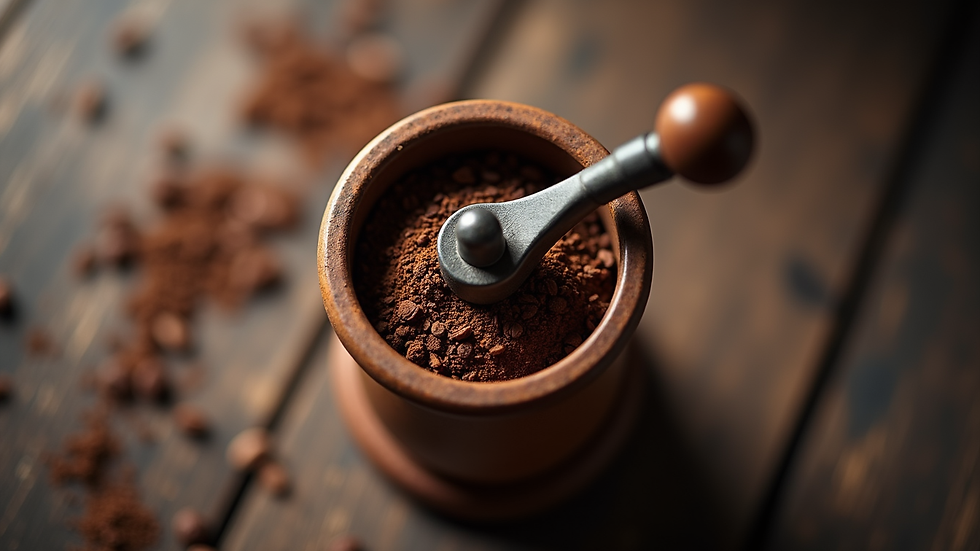
Eye-level view of a hand grinder with coffee grounds
Choosing the right grinder for your coffee journey
At iO Coffee Vietnam, we believe that every step in coffee making matters. That includes the grinder you use. For example, the iO Coffee Burr Grinder offers precise grind size control and consistent particle distribution. It’s designed to help you unlock the full flavor potential of Vietnamese specialty coffee. You can learn more about it here.
If you prefer a manual option, the iO Coffee Hand Grinder combines portability with burr grinding technology. It’s perfect for those who want control and quality on the go. Check it out here.
For those starting out or on a budget, the iO Coffee Blade Grinder provides a simple way to grind beans. While it doesn’t offer the same consistency as burr grinders, it’s a step up from pre-ground coffee and helps you explore the impact of fresh grinding. More details are available here.
How grinding shapes your coffee experience
Grinding affects how water flows through coffee, how much sweetness is extracted, and how balanced the acidity feels. It also influences how clearly the coffee expresses its origin.
A great cup is rarely made by one perfect piece of equipment. It happens when every step—from farming and processing to roasting, grinding, brewing, and serving—works together with care.
Sometimes, the smallest particles have the biggest influence.

High angle view of freshly ground coffee in a portafilter
Final thoughts
Adjusting grind size or upgrading your grinder can make a big difference in your brewing. For me, learning to dial in the right grind size was a game changer. But having a grinder that produces consistent particles made the biggest impact on flavor and repeatability.
If you want to explore the science behind every cup, start with your grinder. Respect the bean. Respect the hands.
What has made the biggest difference in your brewing experience: adjusting grind size or upgrading your grinder? Feel free to share your story and tag a coffee friend who loves exploring coffee science.


Comments